Buying Guide
Choosing Tile Flooring in Apex, Cary and Holly Springs: Porcelain, Size, Slip Rating and Grout
Tile is the most durable floor you can put in a house, and in western Wake County it is what most people want in bathrooms, laundry rooms and entryways, and increasingly in kitchens and open living areas too. The trouble is that tile shopping is mostly about looks, while the things that decide whether a tile floor lasts are printed in small type on the spec sheet. This guide explains the specifications that matter, porcelain versus ceramic, slip rating, tile size, and grout, so you can choose a tile for your Apex, Cary or Holly Springs home with the same confidence you choose the color.
Porcelain or ceramic?
Both are fired clay, but porcelain is made from finer, denser clay fired at higher temperatures. The industry definition is water absorption: porcelain absorbs 0.5 percent or less of its weight in water.
In practice, porcelain is harder, more resistant to chipping and more stable, and it is suitable for any floor in the house, including showers and wet areas. Many porcelain tiles are through-body or color-body, meaning the color runs through the tile, so a chip is far less visible.
Ceramic is softer, easier to cut and usually less expensive. It is a perfectly good choice for walls, backsplashes and light-traffic floors such as a guest bathroom. For a kitchen, a mudroom or a main living area, we recommend porcelain.
The specifications on the box
A tile's spec sheet tells you more than the showroom display. These are the numbers worth reading:
- ✓PEI rating (wear): glazed tiles are rated on a scale from 0 to 5. Class 3 handles all residential floors; class 4 or 5 is for heavy traffic. A class 1 or 2 tile is a wall tile, however good it looks on the floor.
- ✓DCOF (slip resistance): the industry standard asks for a wet DCOF of at least 0.42 for level interior floors that may get wet. Bathrooms, kitchens and entries should meet it. Polished tiles often do not.
- ✓Rectified edges: tiles cut precisely square after firing, allowing narrow grout joints around 1/16 to 1/8 inch. Non-rectified tiles vary slightly in size and need wider joints.
- ✓Shade variation: often labeled V1 to V4. V1 is uniform; V4 varies widely from tile to tile, which looks natural in stone- or wood-look designs but needs careful blending during installation.
Large-format tile: the look and the catch
Tiles 24 by 24 inches, 12 by 24 inches and larger are the most requested look in newer Apex and Holly Springs homes. Fewer grout lines make a room look bigger and cleaner, and they are easier to keep clean.
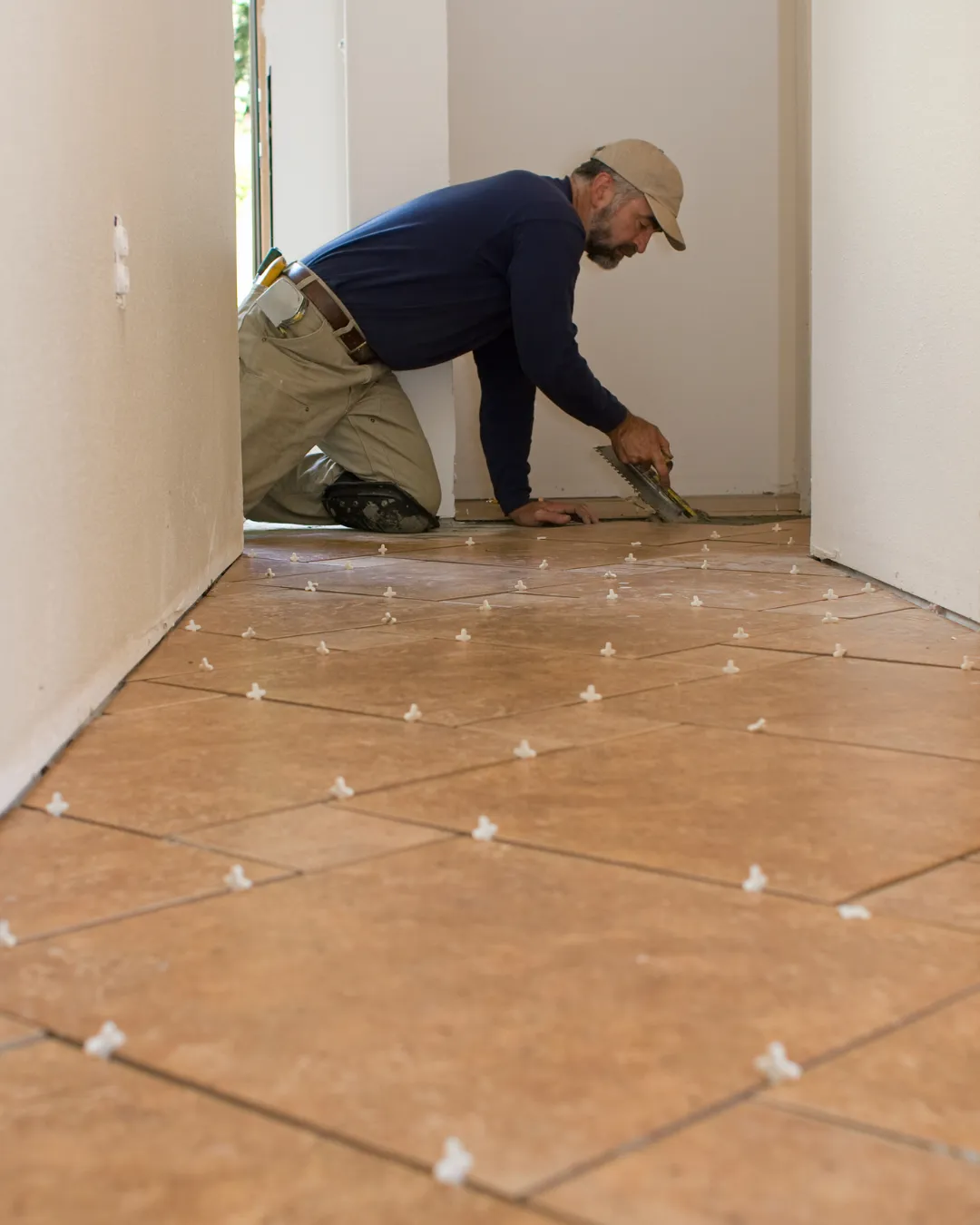
The catch is flatness. Any tile with a side 15 inches or longer counts as large-format, and industry standards call for the floor under it to be flat within 1/8 inch over 10 feet. A normal subfloor rarely meets that without preparation. Large tiles are also slightly bowed from the kiln, so they need full mortar coverage and, often, a leveling system to keep neighboring edges even. Uneven edges between tiles, called lippage, are the most common complaint on a large-format floor. Almost always, the cause is subfloor preparation, not the tile.
That is why a large-format tile quote should include floor preparation. If two quotes differ greatly, check whether one has left it out.
Wood-look plank tile
Porcelain plank tile, usually 6 by 36 or 8 by 48 inches, gives the look of hardwood with none of the moisture risk. It is a strong choice for a bathroom that should match the hardwood in the hallway, or for a whole main level on a slab.
Two things to know. First, plank tiles should generally be laid with an offset of no more than one third of the tile's length. The familiar 50 percent offset of real wood floors lines up the slight bow in each tile and causes lippage. Second, choose a grout close to the tile color and a narrow joint, so it reads as wood rather than tile.
Grout: cement, urethane or epoxy
Grout causes more tile maintenance than the tile itself, and there are three main types.
Cement-based grout is the traditional choice and the least expensive. It is porous, so it needs sealing and periodic resealing, and light colors stain in kitchens and entries.
Urethane and other premixed grouts come ready to use, resist stains better and generally do not need sealing. They cost more and require careful installation.
Epoxy grout is the most stain-resistant and durable, well suited to kitchens, laundry rooms and bathrooms that see a lot of water. It is harder to install and costs more, but it is the lowest-maintenance option.
Color matters as much as type. A mid-tone or darker grout hides everyday dirt much better than bright white. Our post on tile patterns and layouts shows how grout color and pattern work together.
What goes under the tile
Tile is rigid and cannot flex with the floor. Over a wood subfloor, as in most crawlspace homes, the floor must be stiff enough before tile goes down; natural stone needs an even stiffer floor than ceramic or porcelain. Bouncy floors crack grout and eventually tile.
Over the subfloor goes either cement backer board or an uncoupling membrane. An uncoupling membrane lets the subfloor and tile move slightly independently, which reduces cracking, and it is our preference for most floors. On a concrete slab, existing cracks need attention first, because a crack in the slab will often reappear through the tile.
If you want warm tile in a winter bathroom, this is also when electric radiant heating mats go in. They are thin, sit under the tile and are much easier to install during a new tile floor than later. Our guide to tile installation covers the installation side in detail.
Where tile works best in a Triangle home
Tile belongs anywhere water is part of the room. For the rest of the house, it is a choice, and it is worth thinking about how the room is used.
- ✓Bathrooms: porcelain with a slip-resistant surface; smaller mosaic tiles in showers for grip and drainage
- ✓Laundry and mudroom: porcelain with a darker, stain-resistant grout
- ✓Kitchen: porcelain works well but is hard on dropped dishes and on feet during long cooking sessions; many clients choose waterproof LVP here instead
- ✓Entry and foyer: porcelain, or natural stone for a more formal look
- ✓Main living area on a slab: large-format or wood-look porcelain, ideally with rugs and radiant heat for comfort
Tile installation in Apex, Cary and Holly Springs
Our Angier showroom is about 25 minutes from Holly Springs, 30 from Apex and 35 from Cary, and we bring tile samples to your home to see in your own light. At the estimate we check the subfloor's stiffness and flatness, discuss where tile meets other floors, and itemize preparation, membrane and grout in the written quote.
APW has installed tile across central North Carolina since 1973 with our own background-checked, trained installation professionals, and every job carries our 100% product and labor guarantee. See tile flooring in Apex, tile flooring in Cary, tile flooring in Holly Springs and flooring installation in Holly Springs, or book a free estimate.
Ready To Plan Your Floors?
Get a free in-home or in-store consultation with our Angier team. We match the right product to every room and back it with a 100% satisfaction guarantee.
Get My Free Estimate